publications
For the latest publication list, please see Google Scholar.
2025
- Small
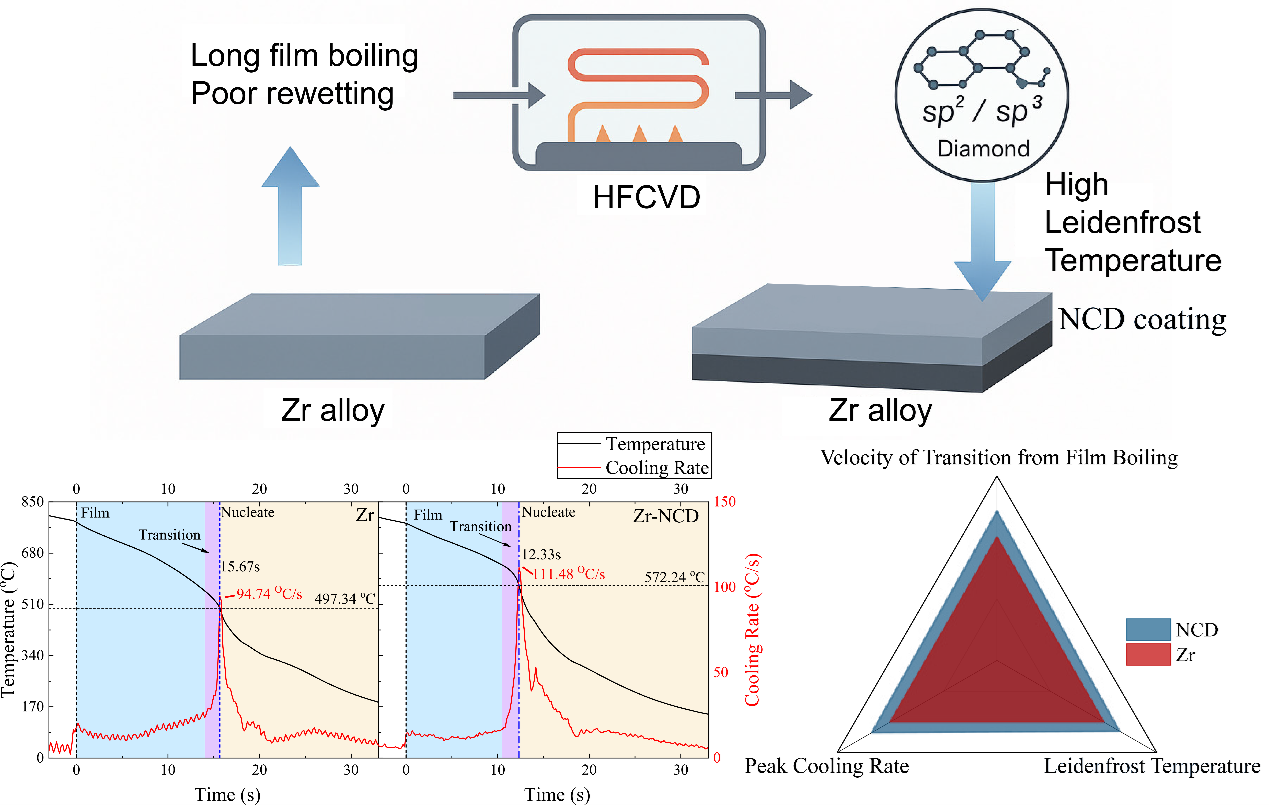 Surface Modification of Zirconium Alloy with Nanocrystalline Diamond: Enhancing Quenching Performance for Accident Tolerant FuelWei Xu, Ningkang Zhao, Meiqi Song, and 1 more authorSmall, 2025
Nuclear energy remains a critical component of the global energy, yet its safety, particularly under extreme conditions, has been a major concern since the Fukushima Daiichi accident. Zirconium (Zr) alloys are widely used as fuel cladding in light water reactors due to their excellent nuclear properties, but their reaction with high-temperature steam during loss-of-coolant accidents(LOCA) poses a significant risk of hydrogen explosions. To enhance the accident tolerance of Zr alloy cladding, this article proposes a surface modification approach using nanocrystalline diamond (NCD) coatings to improve boiling heat transfer performance. High-temperature quenching experiments are conducted, supported by high-speed camera, scanning electron microscopy (SEM), and Raman spectroscopy. The results demonstrate that the NCD coating (1 \( μm \) thick) significantly enhances heat transfer performance: it reduces re-wetting time (12.33 s vs. 15.67 s, a 21.3% improvement), increases the maximum cooling rate (111.48 \( ^∘C s^{−1} \)vs. 94.73 \( ^∘C s^{−1}\), a 17.7% enhancement), and elevates the Leidenfrost temperature to 572.24 (15.06% higher than bare Zr alloy). Thermodynamic parameter calculations indicate that the NCD enhances heat transfer efficiency by improving the solid–liquid contact temperature parameter (\(kρc \)). Furthermore, Raman spectroscopy confirms the coating’s stability. This article provides critical experimental and theoretical insights for developing accident tolerant fuel (ATF) claddings, offering significant implications for improving the safety of nuclear reactors.
2024
- HeliyonCorrosive effect on saturated pool boiling heat transfer characteristics of metallic surfaces with hierarchical micro/nano structuresWei Xu, Longchang Tang, Ningkang Zhao, and 3 more authorsHeliyon, 2024
Surface modification is of critical interest to enhance boiling heat transfer in terms of heat transfer coefficient or critical heat flux (CHF), which is significantly affected by distinct surface morphology and wettability and it can improve the efficiency and safety of equipment. Furthermore, actual service environment may cause severe corrosion to the processed structured surfaces while its consequence on boiling heat transfer is still obscure. In this article, comprehensive researches are conducted to unravel corrosive effect on metallic samples made of stainless steel (SS) and Inconel materials with microstructures. Different constructions (i.e., microgroove, microcavity and micropillar array) and characteristic dimensions (\( ∼\)20, 50 \( μm \)) of microstructure, various duration time (up to 300 days) and pH values (\( ∼\)7.0–8.5) of corrosive environment are compared thoroughly. Conclusions can be drawn that not all microstructures can enhance pool boiling heat transfer characteristics, especially in terms of CHF values. More importantly, CHF value of SS microgroove sample firstly increases from 60.94 to 94.09 \(W⋅cm^{−2} \)in 50 days, then decreases to 47.77 \(W⋅cm^{−2} \)in 300 days, which can be attributed to competition result between formation of hierarchical micro/nano structure with enhancing wicking capability and chemistry condition with increasing contact angle. In addition, distinct bubble dynamics during pool boiling is also analyzed. The insights obtained from this article can be used to guide surface modification method and to reveal evolvement rule of engineered metallic surface in highly corrosive and harsh boiling heating transfer environment.
- Small
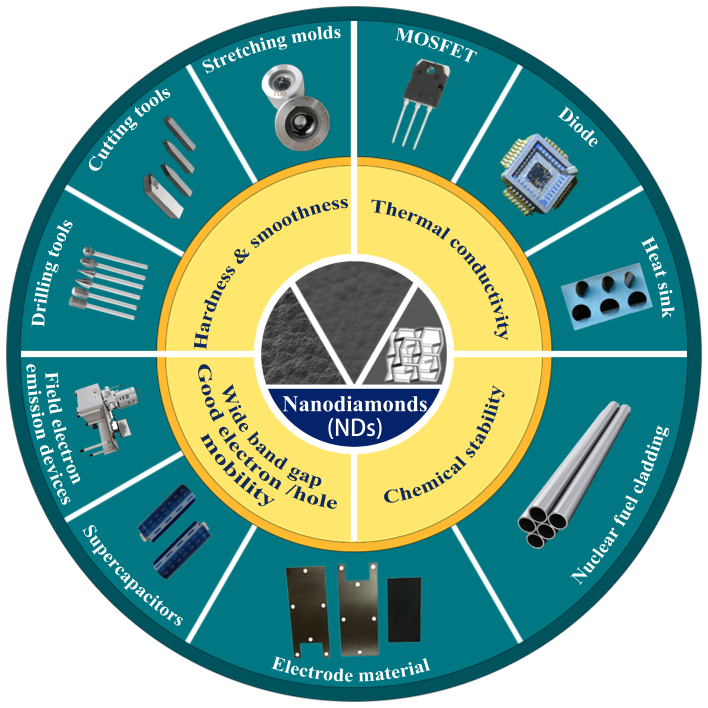 Nanodiamond coating in energy and engineering fields: synthesis methods, characteristics, and applicationsNingkang Zhao, Meiqi Song, Xifang Zhang, and 2 more authorsSmall, 2024
Nanodiamonds are metastable allotropes of carbon. Based on their high hardness, chemical inertness, high thermal conductivity, and wide bandgap, nanodiamonds are widely used in energy and engineering applications in the form of coatings, such as mechanical processing, nuclear engineering, semiconductors, etc., particularly focusing on the reinforcement in mechanical performance, corrosion resistance, heat transfer, and electrical behavior. In mechanical performance, nanodiamond coatings can elevate hardness and wear resistance, improve the efficiency of mechanical components, and concomitantly reduce friction, diminish maintenance costs, particularly under high-load conditions. Concerning chemical inertness and corrosion resistance, nanodiamond coatings are gradually becoming the preferred manufacturing material or surface modification material for equipment in harsh environments. As for heat transfer, the extremely high coefficient of thermal conductivity of nanodiamond coatings makes them one of the main surface modification materials for heat exchange equipment. The increase of nucleation sites results in excellent performance of nanodiamond coatings during the boiling heat transfer stage. Additionally, concerning electrical properties, nanodiamond coatings elevate the efficiency of solar cells and fuel cells, and great performance in electrochemical and electrocatalytic is found. This article will briefly describe the application and mechanism analysis of nanodiamonds in the above-mentioned fields.